

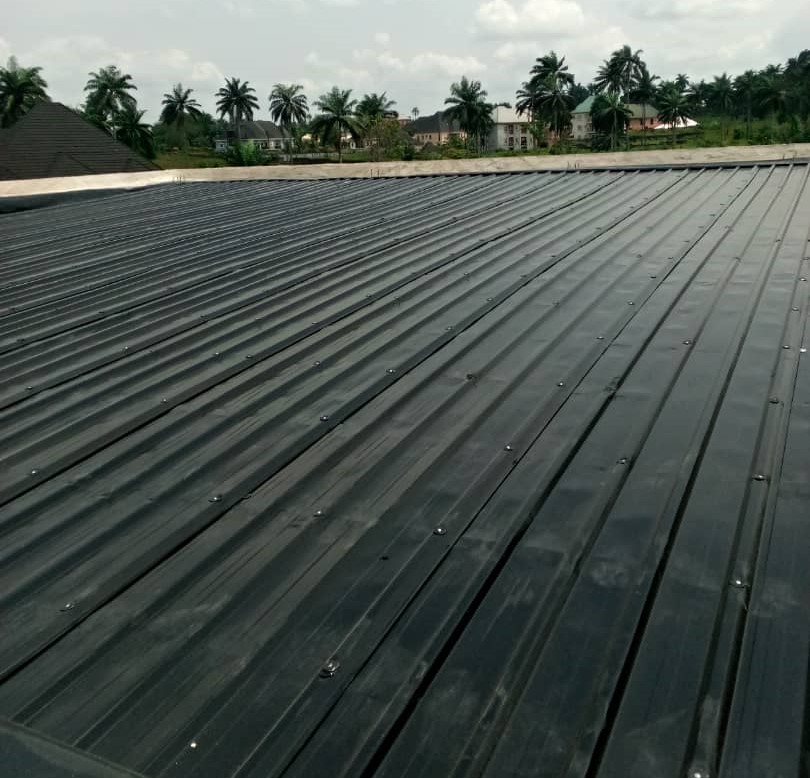
There are different roof types but the one which a lot of people have issues with when it comes to construction and long-term functionality is the hidden monopitch roof… that is the type of roof you will not see when looking at a building. It is blocked off with block work and it is within the perimeter of the building above.
It gives a contemporary feel and timeless look to the building but we have a lot of people complain that this type of roof leaks when they use it in their buildings.
The main cause of this failure is not following standards…everything has a process let’s look at ways to avoid leakages in this type of roof.
Use correct metal roof guage
There are different possible gauges you can use for your roofing but the lesser the gauge the more the possibility of tearing wobbling or breaking which will allow water into the roof hence the building.
Considering cost and quality, is 0.55mm gauge is a good specification to consider for use on such roofing types as it is strong enough to withstand traffic while installing and durable for long-term use. Lesser gauges may leak over time as they have lesser quality.
Use adequate slope
Water requires a good slope to run off.
Once the slope is not adequate, water may pool in an area and start to find a way out through the roof below. While some specifications are available, generally try to get about 5° or more where possible. This will enable smooth runoff of water prevent water from stagnating and leaking into the building.
Use flashing and counterflashing at edges
When it comes to water leakage management either in concrete or aluminum roofs, the edges are always a critical point because there are joints there which needs special treatment.
After laying your aluminum roof on the trusses, lap it over with flashing turned up to the wall then put another counter flashing covering the edge where the flashing meets the wall such that it acts as a protection to prevent water from seeping into the flashing… the flashing in turn prevents water from entering into the roof
Seal off nail points
Nails which are used to hold the roofing sheet to the trusses create holes in the roof and can be a weak point for water ingress.
It is easy to handle this as there are nail caps and sealants you can apply at each of the nail points to permanently seal off any little gap and water seeping into the building.
Overlap the aluminium sheets properly
Aluminum sheets come in sizes which have to be combined together to cover your whole roof.
Due to this you have to overlap the sheets over one another for proper installation, if you lap a little there is a risk of water from driving rain blowing into the gaps. Strong wind could also blow open the edge where the roofs overlap so a good practice will be to double it over to grooves and nail properly to prevent this occurrence.
Drain roof gutter properly
You may leave the back of your monopitch roof to drain freely out of the building but some designs have roof gutters at the back for aesthetics or functional reasons…
In this case, the roof gutter has to be properly constructed with adequate width and depth and also drain pipes to take the water away sufficiently from the roof.
Failure to do this will cause water staying within the gutter and causing leakage over time.
Conclusion
Hidden monopitch roof is as good as any other roof, you only have to follow the rules, follow the process and most of all get a good installer.


0 Comments